FABILIS Research
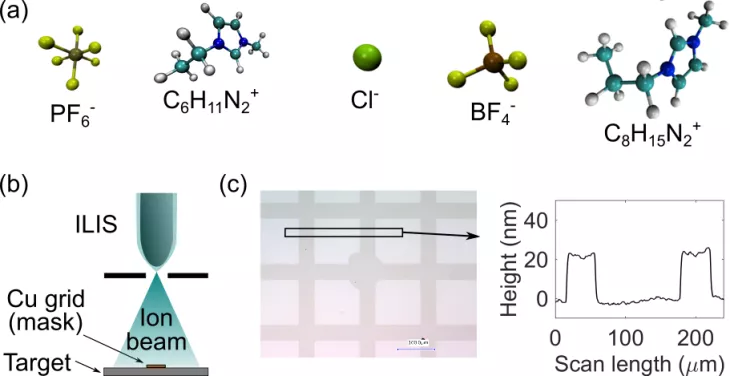
Our research is based on Ionic Liquid Ion Sources (ILIS). ILIS are electrospray devices that produce ion beams by means of field evaporation from ionic liquids.
What are Ionic Liquid Ion Sources (ILIS)?
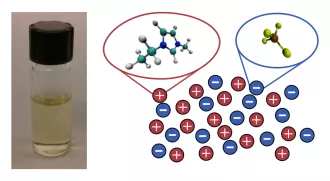
Ionic liquids are room temperature molten salts, or mixtures of cations or anions that are liquid at room temperature with no intervening solvent. You can think of it as a plasma in a bottle. The cations are usually large organic molecules, while the anions may be complex organic or simple inorganic ions. Ionic liquids have attracted much interest in energy storage and electrochemical synthesis, thanks to their stability, non-volatility, appreciable electrical conductivity, large electrochemical windows, and their suitability as solvents.
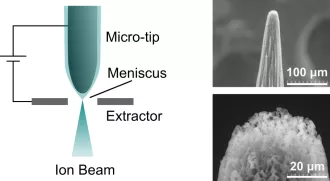
In ILIS, a micro‑tip emitter is covered with ionic liquid and biased to a high voltage with respect to a downstream metallic extractor. The electric field causes the liquid to deform into a sharp meniscus. At the apex of the meniscus, the electric field is high enough to trigger evaporation of ions from the liquid. The resulting beam can be used to treat materials.
Why ILIS for nanomanufacturing?
- ILIS are amenable for focusing, so could be implemented in focused ion beams (FIB), a tool ubiquitous in nanotechnology for fabrication and characterisation.
- ILIS are versatile – we have access to positive and negative ions, as well as many ion chemistries.
- We can optimise the choice of liquid for the particular application.
- Fast etching has been demonstrated with ILIS, thanks to the reactivity of the ions in the beam.
Our Work - Four Areas of Research
-
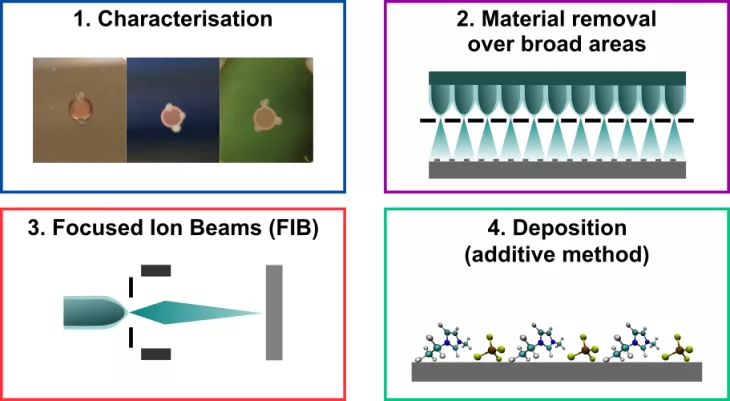
Characterisation: Explore the range of ion species produced by ILIS and their interaction with different substrate materials.
-
High‑throughput material removal: Investigate multiplex arrays of ILIS for scalable processing and faster material removal.
-
Focused Ion Beams (FIB) based on ILIS: Design and construct a bespoke focusing column for ILIS beams and implement it in an existing FIB system.
-
Deposition: At sufficiently low beam energy, deposit thin films of ionic liquids to study ionic liquid interfaces and surface phenomena.
Key Publications
These early papers describe the foundational techniques behind our work.